Walk into almost any American factory tour, ribbon-cutting, or defense-industry briefing and you will hear a comforting story: we still melt titanium, we still assemble transformers, we still bottle antibiotics, we still fly with sophisticated inertial navigation. The buildings are real. The workers are skilled. The logos on the gates are familiar.
Then you ask a quieter question—where does the precursor come from?—and the story changes.
America’s industrial blind spots are not primarily “finished goods” problems. Across seven strategic categories that matter for health, energy, mobility, and national security, the recurring pattern is the same: upstream precursors and thin sub-tiers are the true chokepoints, while downstream assembly, melting, finishing, or finished-dose capacity often still looks present on paper. That illusion—capacity that looks sovereign until you pull the bill of materials—is the central finding of the Strategic Industrial Sovereignty Assessment (SISA), and the reason for this twelve-post series.
This opener maps the landscape. It will not steal the deep dives. It will show you why the map matters, how we rank what can be re-shored, and why industrial CapEx alone is not enough.
The comforting illusion of the finished object
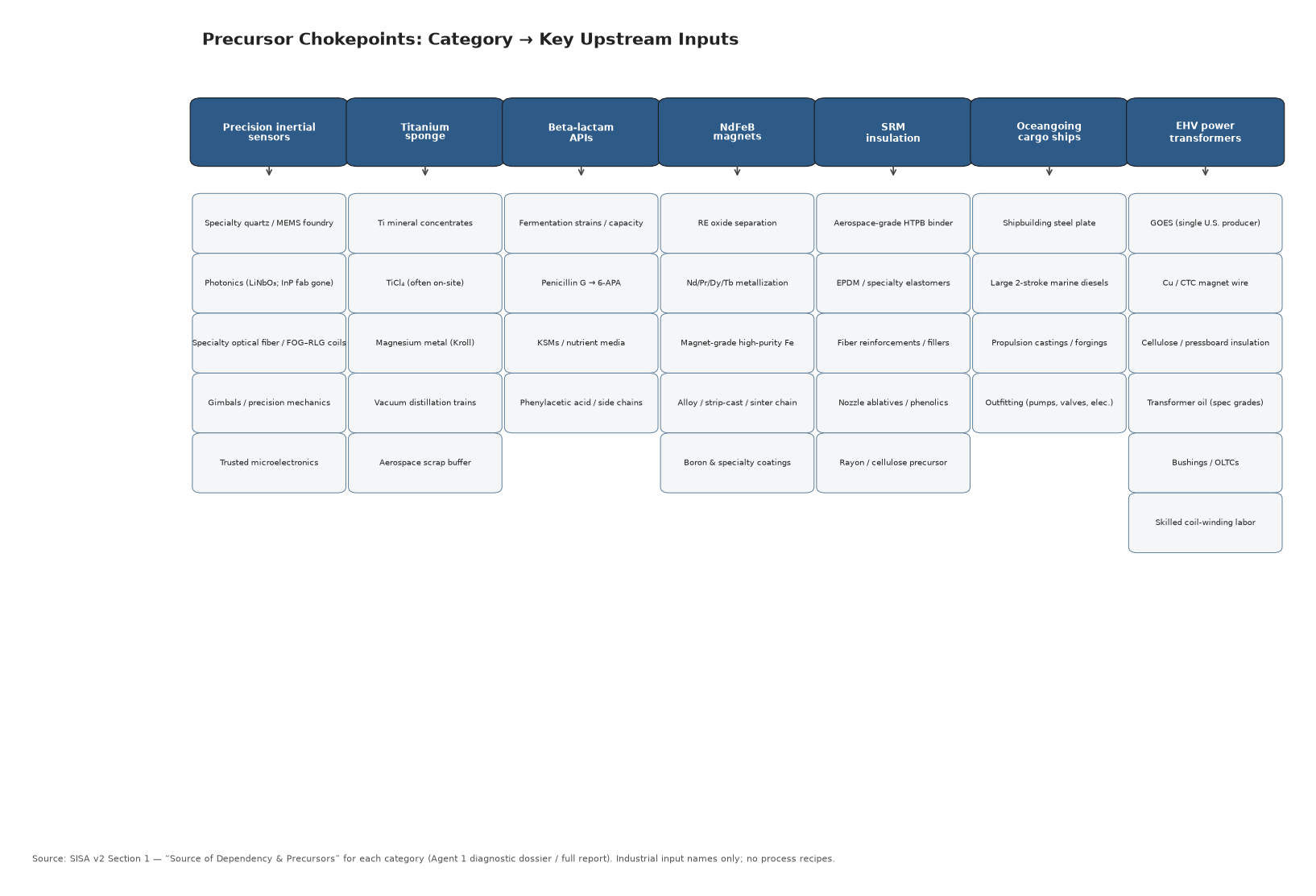
Finished objects are photogenic. A large power transformer on a flatbed, a magnet plant groundbreaking, a pharmacy shelf restocked with amoxicillin—these look like sovereignty. Precursors do not photograph well. Grain-oriented electrical steel coils, titanium sponge, 6-APA intermediates, heavy rare-earth metals, specialty optical fiber, aerospace-grade binder resins: these are the quiet ingredients that decide whether the photogenic object can be made at all, and whether it can be made again after a shock.
SISA’s diagnostic work, drawn from open-source government and industry reporting, finds three overlapping patterns:
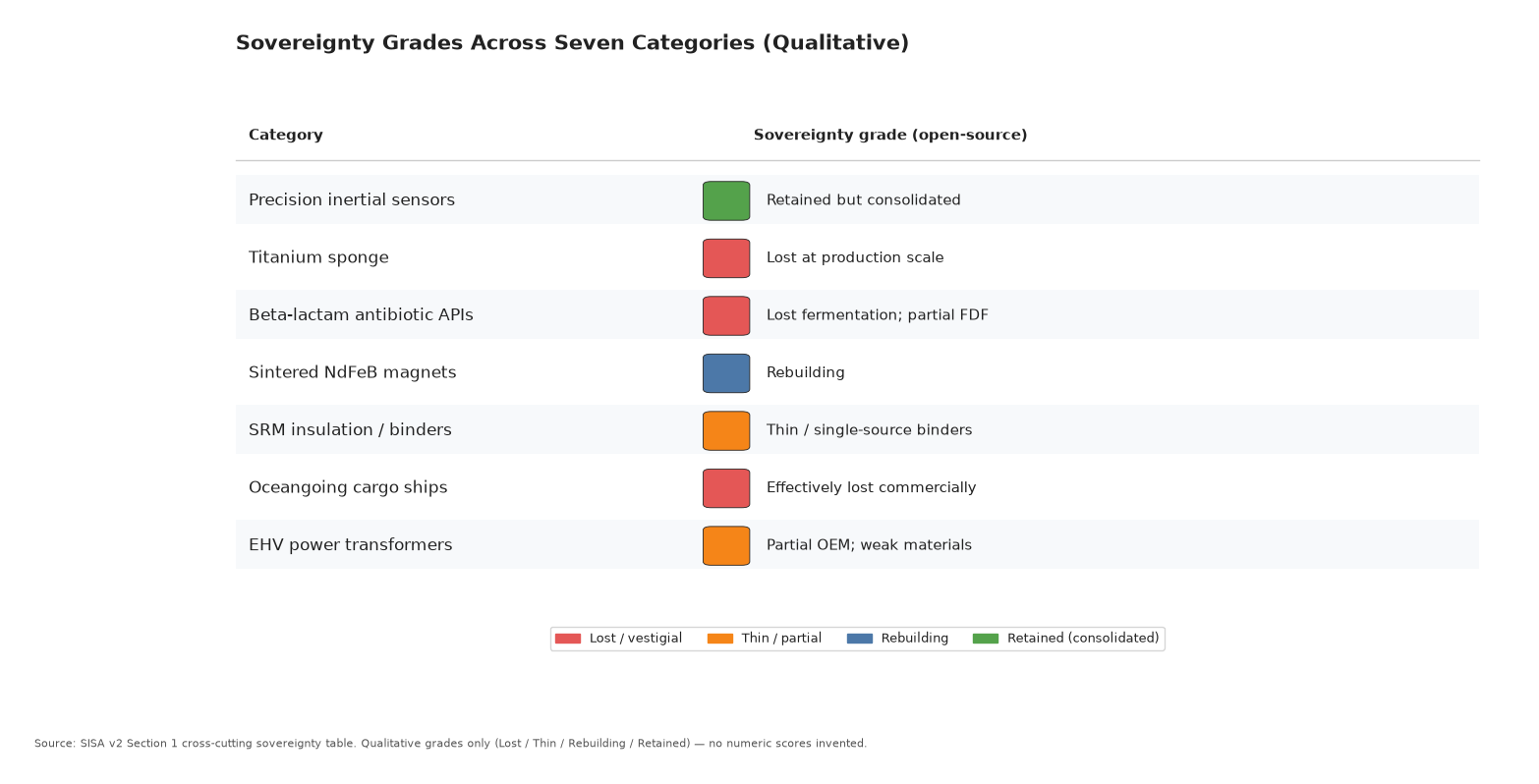
Lost or vestigial primary capacity. The United States produced no titanium sponge metal in 2025 after the last domestic plant closed in 2024; downstream melt shops still exist, but they run on imported sponge and scrap. Penicillin and β-lactam fermentation—and the 6-APA intermediate that feeds modern oral antibiotics—are effectively absent domestically, even as finished-dose capacity has partially returned. Commercial oceangoing cargo shipbuilding is vestigial: recent tallies put U.S. yards at on the order of three large cargo vessels among roughly 5,448 on order worldwide.
Retained but consolidated / thin. Guidance-grade inertial capability survives inside primes and specialty suppliers—but photonic fab depth and upstream fiber tiers have narrowed. Solid-rocket-motor insulation and aerospace-grade binder supply sit on dangerously thin qualified benches. Extra-high-voltage large power transformers meet only a minority of U.S. demand; grain-oriented electrical steel (GOES) from a single domestic producer is the binding materials constraint.
Rebuilding under way but unfinished. Sintered rare-earth magnet campuses are commissioning with billion-dollar CapEx—yet heavy rare-earth metallization and magnet-grade iron remain upstream risks. Transformer OEM expansions and magnet plants that ignore feedstock simply relocate the chokepoint. A ribbon-cutting without a precursor plan is a relocation of risk, not a cure.
If you remember only one sentence from this series, make it this: stop mistaking downstream assembly for sovereignty.
Seven categories, one recurring story
We will spend Posts 2–8 walking each category carefully, with sources, caveats, and honest confidence grades. For this opener, a map is enough—seven names, seven binding chokepoints, no how-to, no chemistry, no munitions guidance.
- Precision inertial sensors — Retained but consolidated. Specialty quartz, photonics tiers, and fab closures matter more than the brochure photos of finished IMUs.
- Titanium sponge — Lost at production scale. Melt shops without sponge are incomplete sovereignty; magnesium metal as reductant is a coupled risk.
- Beta-lactam antibiotic APIs — Lost fermentation; partial finished-dose foothold. A U.S. bottle of amoxicillin can still be anchored to foreign key starting materials.
- Sintered NdFeB magnets — Rebuilding. Dy/Tb metallization and magnet-grade iron are the silent precursors behind the campus announcements.
- Solid-rocket-motor insulation supply — Thin sub-tiers and single-source binder risk. Industrial-base status only in this series—no formulations, no process recipes.
- Oceangoing cargo ships — Effectively lost commercially. Engines, cost-competitive plate, and series yard practice dominate the decade problem.
- EHV power transformers — Partial OEM capacity; weak materials. GOES, copper magnet wire, bushings, and skilled winding labor decide lead times measured in years.
Ally sourcing can soften some of these—Japanese sponge, Korean shipbuilding partnerships, allied electrical steel—but ally mitigation is not the same as domestic depth, and some chains (β-lactam KSMs historically tied through China even when finished doses come from India; ITAR-bound insulation qualifications) mitigate poorly. The point of the map is triage: know what is lost, what is thin, and what is merely relocated.
Dual path: re-shore what you can; adapt what capital cannot deliver in time
Sovereignty, in SISA’s framing, is not a single CapEx bill. It is a continuous practice with two parallel tracks.
Path A — Industrial re-shoring, ranked by feasibility
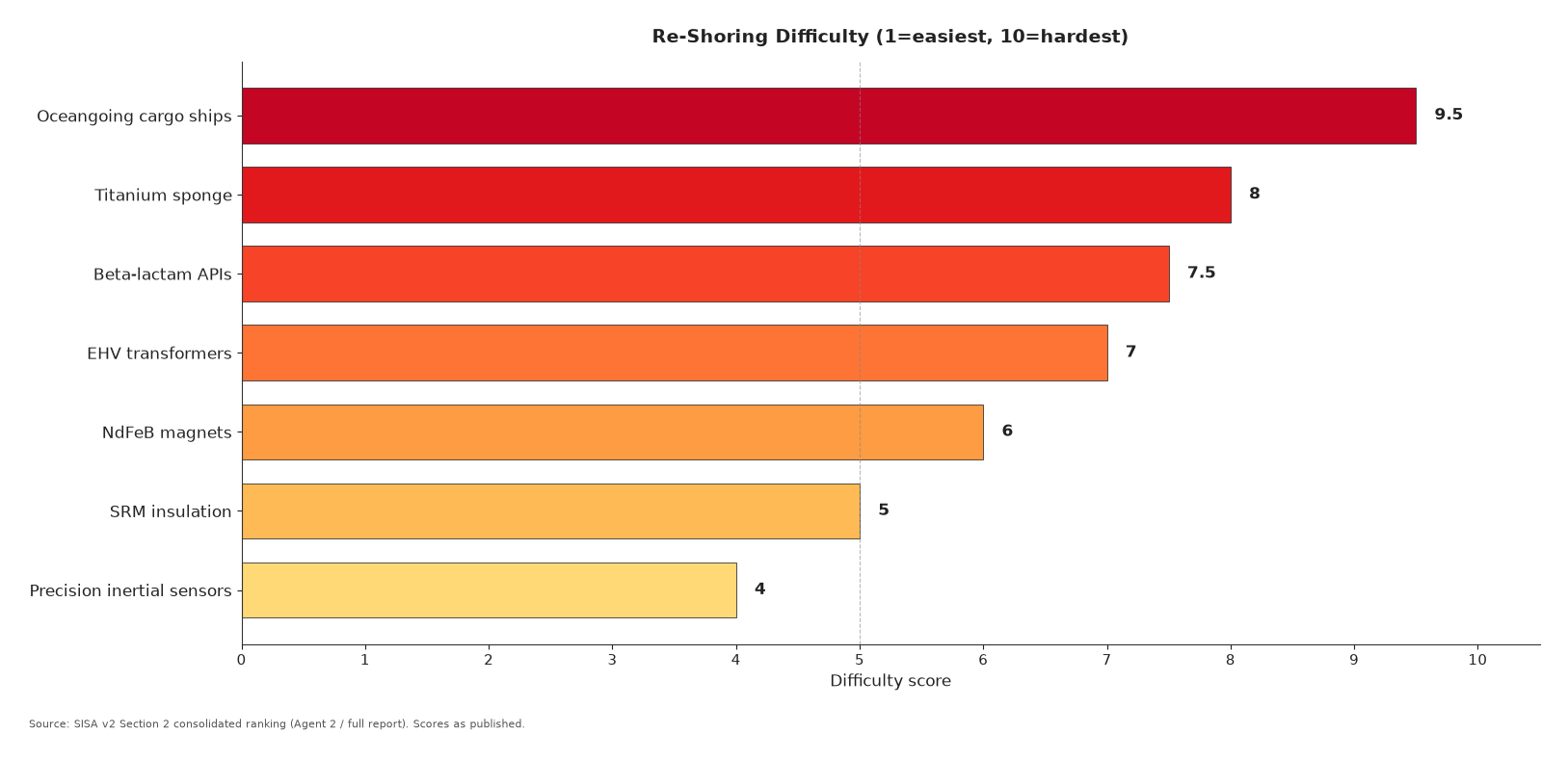
Difficulty does not track strategic importance. Lowest-hanging fruit are sectors where a U.S. industrial nucleus still exists and CapEx is tens-to-low-hundreds of millions. Highest barriers are zero-domestic primary materials and structural cost-gap heavy industry. Our open-source difficulty scores (1–10 rubric) run roughly like this:
| Rank | Pipeline | Difficulty | Why it sits there |
|---|---|---|---|
| 1 | Precision inertial expansion | 4 | Nucleus exists; buy throughput and upstream fiber/IOC |
| 2 | SRM insulation sub-tier nodes | 5 | Thin but resident know-how; Title III–scale CapEx |
| 3 | Sintered NdFeB magnets | 6 | Campuses funded; feedstock and qualification decide |
| 4 | EHV transformers as GOES + labor | 7 | Factories without electrical steel and winders stall |
| 5 | Beta-lactam API plants | 7.5 | CapEx solvable; unit economics need offtake policy |
| 6 | Titanium sponge restart | 8 | Hard primary plant + atrophied operating crews |
| 7 | Commercial cargo shipbuilding | 9.5 | Decade mega-project; permanent cost/demand gap |
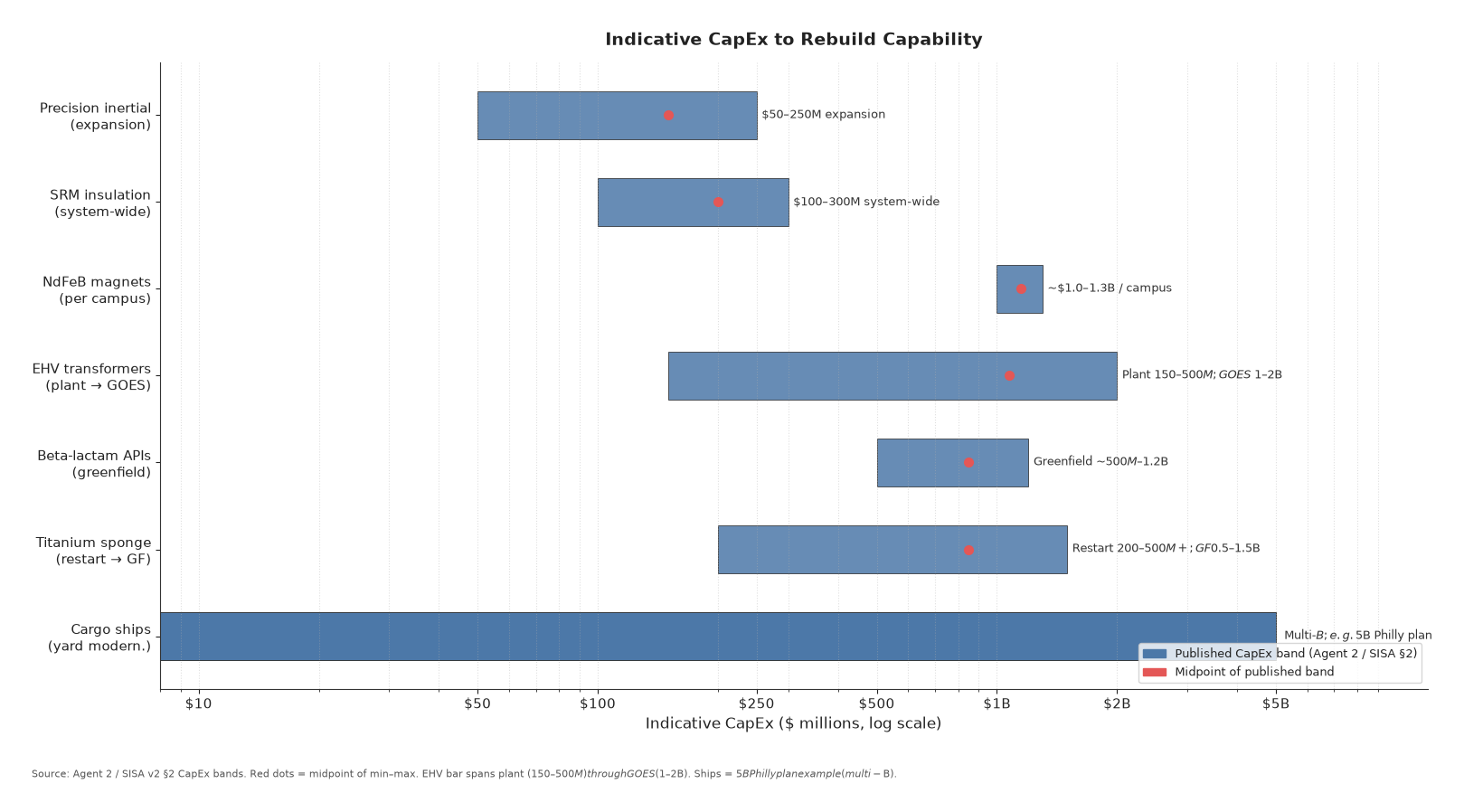
Policy that funds the hardest projects first because they make the best speeches will waste years. Policy that expands what still works—while finishing feedstock follow-through on the rebuild wave—buys sovereignty ROI per dollar. CHIPS- and IRA-era lessons apply: multi-year tax credits, offtake guarantees, and workforce pipelines matter as much as groundbreaking photos. Decade-scale sponge plants and shipyards cannot be “wartime sprint” fantasies without sustained finance.
Path B — Decentralized literacy and civilian COTS Plan B
Garage and makerspace tooling can recover partial precursors and literacy for a few skill chains adjacent to these categories. It cannot recover industrial titanium sponge, sintered NdFeB magnets, antibiotic APIs, SRM insulation chemistry, cargo ships, or EHV grid transformers—and this series will say so every time someone asks for a backyard miracle.
What is in scope for the decentralized path: hobby/educational PCB and lithography literacy; precision machining for robotics and camera gimbals; coil-winding literacy that teaches why transformer labor is scarce; food and agricultural fermentation only; supervised aluminum/bronze educational casting. What is explicitly out of scope everywhere in this series: munitions how-to, rocket chemistry, regulated drug synthesis, hazardous lab recipes, and weapons guidance improvisation.
When industrial parts are back-ordered or disaster has stripped certified inventory, civilian Plan B engineering harvests capability from phones, EVs, automotive salvage, and industrial surplus—and compensates for lower tolerances with signal processing, calibration, and software fusion. Think smartphone MEMS with Kalman/sensor fusion for inspection robotics; automotive and industrial salvage swaps for pumps and non-safety utility logic; COTS grid monitoring with clamp-on sensors and open edge stacks. Keep water flowing, grids observed, and inspection robots flying. Stay deliberately useless as a weapons playbook.
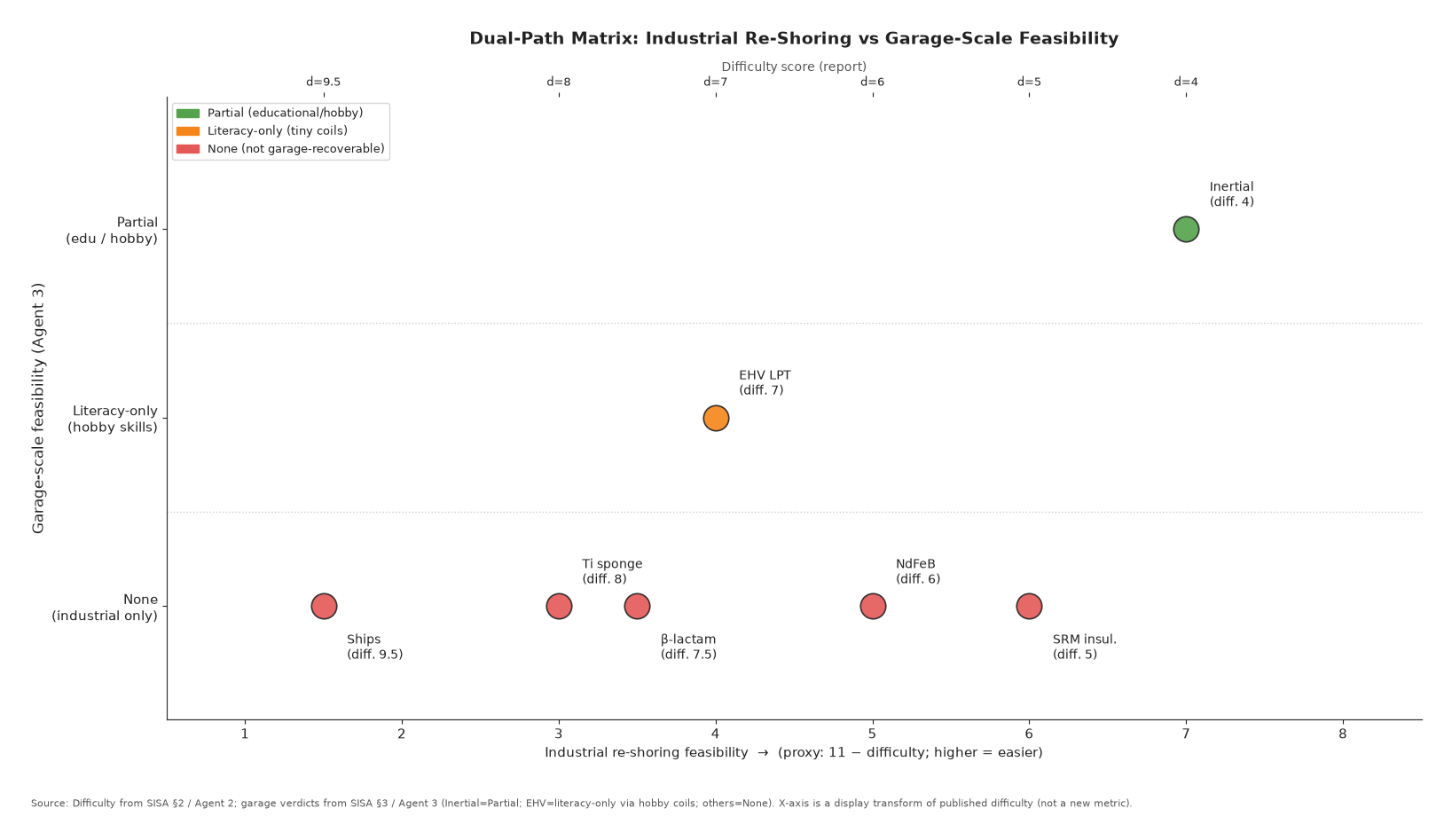
Industrial CapEx and decentralized adaptation are not rivals. One rebuilds plants on a five-to-ten-year clock. The other keeps civilian systems alive on a six-week clock when the plant has not arrived yet.
Shared failure modes worth naming aloud
Across all seven categories, the same failure modes recur:
- Upstream chemicals and minerals gone while downstream assembly remains. Melt without sponge. Finished dose without API. Magnet plant without metal and magnet-grade iron. Transformer assembly without GOES.
- Silent single domestic plants. One GOES producer. Historically thin aerospace binder sourcing. Magnesium distress cascading into any future Kroll restart.
- Qualification inertia measured in years. Losing a qualified sub-tier supplier is not a purchase-order problem; it is a multi-year program delay.
- Thin skilled-labor pipelines. Shipyard series welders, energetics-materials specialists, sponge operators, FOG coil winders, transformer winders—skills that atrophy faster than buildings do.
Catalog what remains. Protect single points of failure before the crisis. Adapt with software and COTS where capital cannot arrive in time. That triad—catalog, protect, adapt—is the operational directive this series will close on in Post 12.
What this series will (and will not) do
Will do: Translate SISA’s open-source assessment into readable public posts for an informed general audience—policymakers, industrial-base planners, journalists, makers, and resilience-minded citizens. Rank feasibility honestly. Separate industrial status from kitchen-table fantasy. Cite the USGS, DOE, GAO, FDA/ASPR, and industry filings that underwrite the claims.
Will not do: Publish munitions guidance, rocket or propellant chemistry, drug synthesis recipes, or hazardous laboratory procedures. Where defense-industrial items appear (inertial base, SRM insulation), we stay at policy and industrial-base altitude: who makes what, how thin the bench is, what dual-sourcing and offtake can fix—not how to build a weapon.
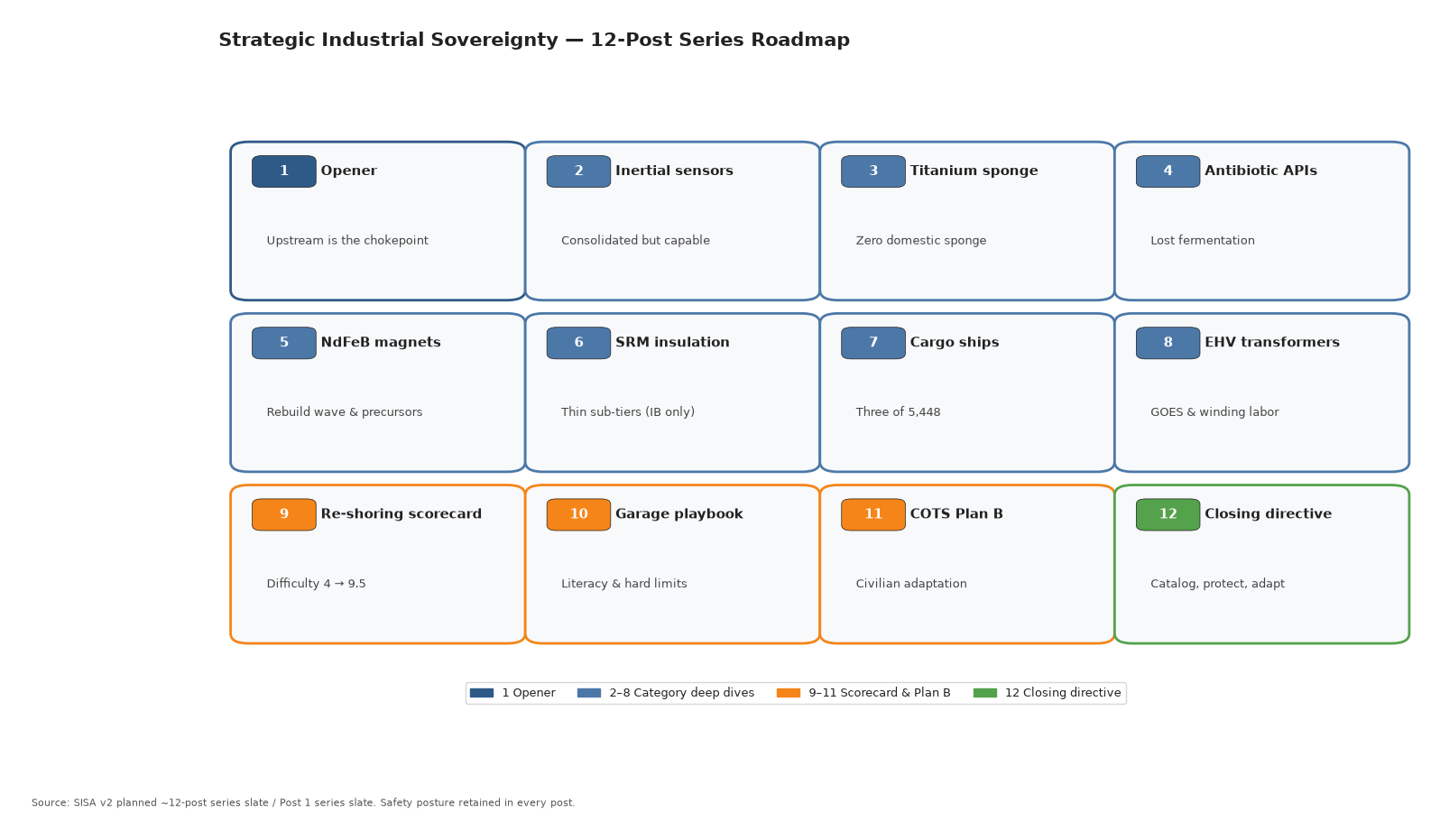
Series slate (12 posts)
- Series opener — Upstream is the chokepoint; dual-path strategy (you are here).
- Inertial sensors — Consolidated but capable; quartz, FOG/RLG, photonic fab closures; what “surge” really means.
- Titanium sponge — Zero domestic sponge; magnesium linkage; melt without sponge is incomplete.
- Beta-lactam antibiotic APIs — Lost fermentation; finished dose ≠ API; SAPIR/BARDA as mitigation, not restoration.
- Sintered NdFeB magnets — The rebuild wave; Dy/Tb and magnet-grade iron as silent precursors.
- SRM insulation industrial base — Thin sub-tiers and binder single-source risk (industrial status only).
- Oceangoing cargo ships — Three of 5,448; engines, plate cost, and the decade mega-project.
- EHV transformers — GOES, winding labor, and why factory photos are not enough.
- Re-shoring scorecard — Difficulty 4 → 9.5 with CapEx, workforce, time-to-first-unit, and policy levers.
- Garage playbook — Benign literacy tracks and hard “not at home” callouts.
- COTS Plan B — Civilian smartphone/AHRS fusion, EV/automotive swaps, grid monitoring.
- Closing directive — Catalog, protect, adapt: plants, precursor maps, and digital public goods.
What’s next
Post 2 opens the category deep dives with precision inertial sensors—the lowest-hanging fruit on the re-shoring ranking (difficulty 4). The United States still has a real industrial nucleus: quartz MEMS, fiber-optic and ring-laser gyros, photonic paths that have narrowed but not vanished. That makes inertial capacity the clearest place to start if the objective is sovereignty return per dollar and per year: expand what still works, shore up upstream fiber and optoelectronic tiers, and be precise about what “surge” can and cannot mean after fab consolidations.
If you care about industrial sovereignty as something more than a slogan, start there with us. Upstream is the chokepoint. The finished object was never the whole story.