← Post 1: Upstream Is the Chokepoint
In Post 1 we argued that America’s industrial blind spots are mostly upstream: precursors and thin sub-tiers, not missing finished-goods photos. Precision inertial sensors are the first deep dive because they break the usual pattern in a useful way. The finished instruments still exist. Quartz MEMS, fiber-optic gyros (FOG), ring-laser gyros (RLG), and photonic paths still sit inside U.S. primes and specialty suppliers. What narrowed is the supporting stack—specialty fiber, integrated optical circuits, and adjacent photonic fab depth—and what aged is the skilled bench that winds coils and qualifies lines.
That is why SISA ranks inertial expansion at difficulty 4: CapEx of expansion, not CapEx of civilization. Buy throughput and upstream localization with Defense Production Act–scale money; measure success in years, not decades. This post stays at policy and industrial-base altitude—who makes what, how thin the bench is, what dual-sourcing and offtake can fix. It is not a build guide for munitions, seekers, or weapons guidance.
The industrial nucleus that still works
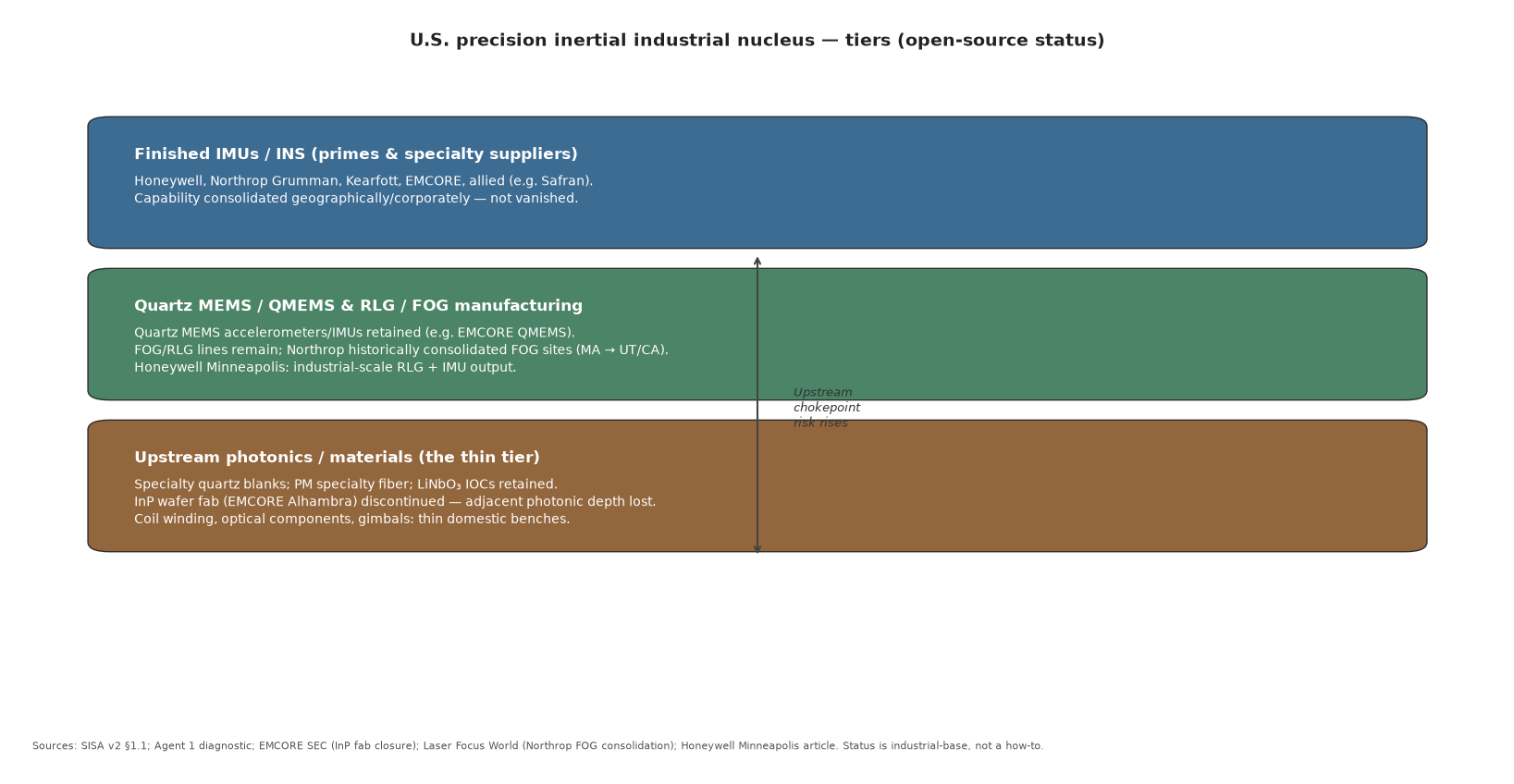
Walk the open-source map and you find concentration, not extinction. Public suppliers include Honeywell, Northrop Grumman, Kearfott, EMCORE, and allied presence such as Safran. Capability has consolidated geographically and corporately rather than vanished. Northrop historically closed Massachusetts FOG sites and moved work to Utah and California. EMCORE acquired KVH FOG/INS assets, then restructured—shutting its Indium Phosphide (InP) wafer fab in Alhambra, California—while retaining quartz MEMS (QMEMS) and lithium niobate builds across Alhambra, Budd Lake (New Jersey), Concord (California), and Tinley Park (Illinois).
The point of that sentence is not nostalgia for a particular fab. It is that adjacent photonic depth can disappear even while product brands remain on the wall. Downstream primes then become captive to fewer plants and longer qualification cycles—the same failure mode Post 1 named for transformers without GOES and melt shops without sponge.
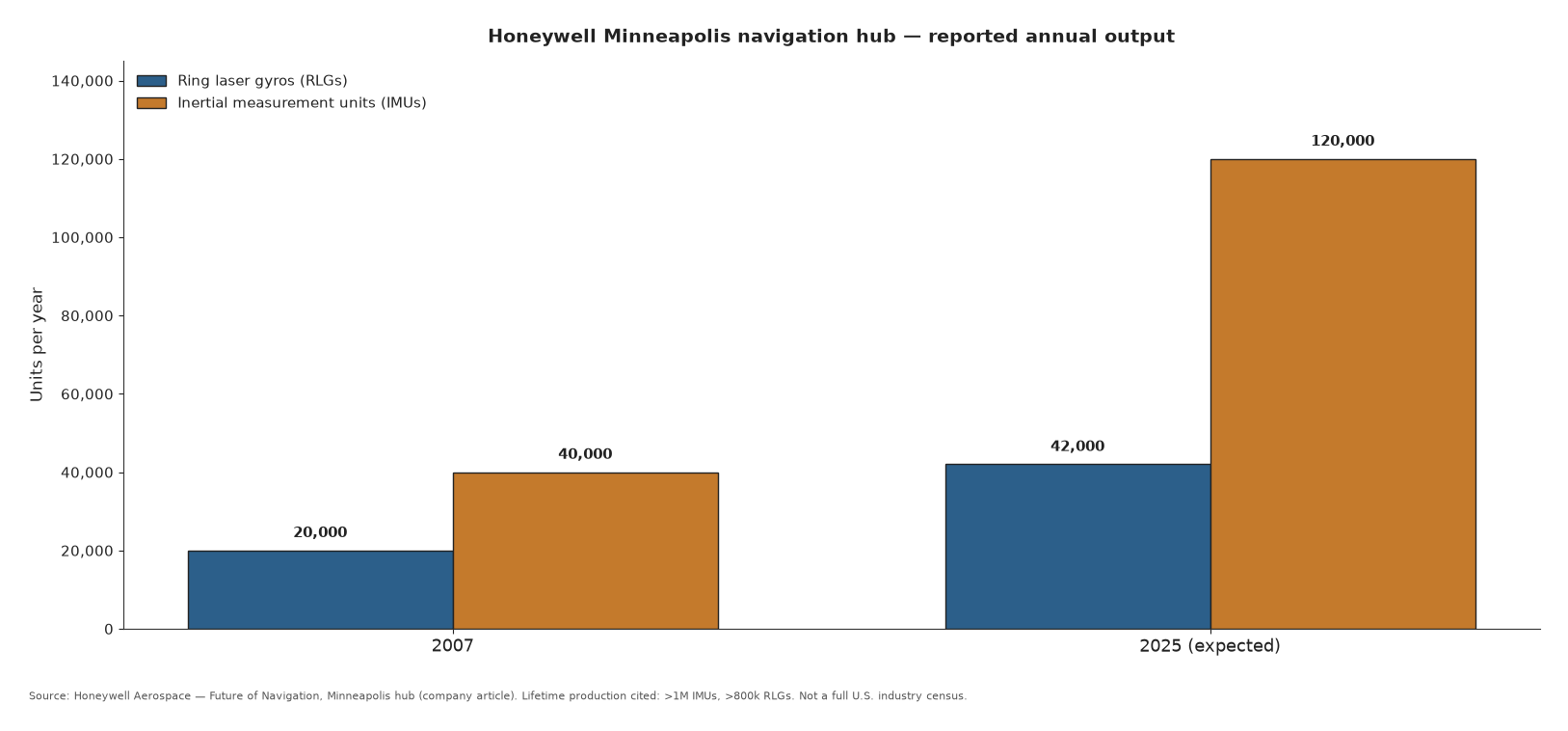
Honeywell’s Minneapolis Inertial Navigation Center of Excellence is the clearest public proof that U.S. manufacturing—not only R&D—still exists at industrial scale. The company reports expected production of roughly 42,000 RLGs and 120,000 IMUs in 2025, up from about 20,000 and 40,000 respectively in 2007, with lifetime site production above one million IMUs and 800,000 RLGs. That is one hub’s disclosed run rate, not a full industry census—but it demolishes the myth that “America doesn’t make navigation-grade hardware anymore.”
Think of the nucleus in three tiers:
- Finished IMUs / INS at primes and specialty houses—still capable, fewer addresses.
- Quartz MEMS / QMEMS and FOG / RLG manufacturing—retained lines, consolidated sites, real throughput at places like Minneapolis.
- Upstream photonics and materials—specialty quartz blanks, polarization-maintaining fiber, lithium niobate integrated optical circuits (IOCs), coil winding, optical components, precision gimbals. This is where the bench is thin and where InP fab exit bites.
What was lost or consolidated (without losing the story)
Three losses matter more than brochure photography:
Geographic consolidation. Moving FOG work across state lines can be rational for a firm and still be a national-risk event. Every closed cleanroom is a place where mentors stopped mentoring. GAO’s industrial-base work has long flagged the pattern: specialized, aging-risk workforces that are hard to reconstitute after closures.
Photonic fab exit. EMCORE’s public filings make the InP wafer-fab shutdown explicit. Lithium niobate and QMEMS continued; InP photonic fab capacity was intentionally discontinued. That is not the same as “gyros gone.” It is a loss of adjacent optoelectronics depth that makes future PIC paths and surge options narrower.
Upstream import exposure. Specialty PM fiber and IOCs remain partly exposed to Japan and Europe. Precision ceramics, high-purity optical materials, and related dual-use mechanical assemblies sit on thin domestic or allied benches. Qualification of a new domestic upstream source is measured in 24–36 months, not purchase-order weeks.
Secondary consequences if this nucleus thins further are civil and dual-use as much as defense-industrial: aviation navigation sustainment, space launch and satellite attitude-control throughput, GPS-denied commercial autonomy, and the ability to surge IMU production without allied FOG/QMEMS capacity. Open sources rarely publish plant-by-plant grade mix or spare surge headroom—treat “how much surge exists tomorrow morning” as low confidence. Treat “the nucleus exists and can be expanded” as medium–high.
Precursors, CapEx, and why difficulty is 4
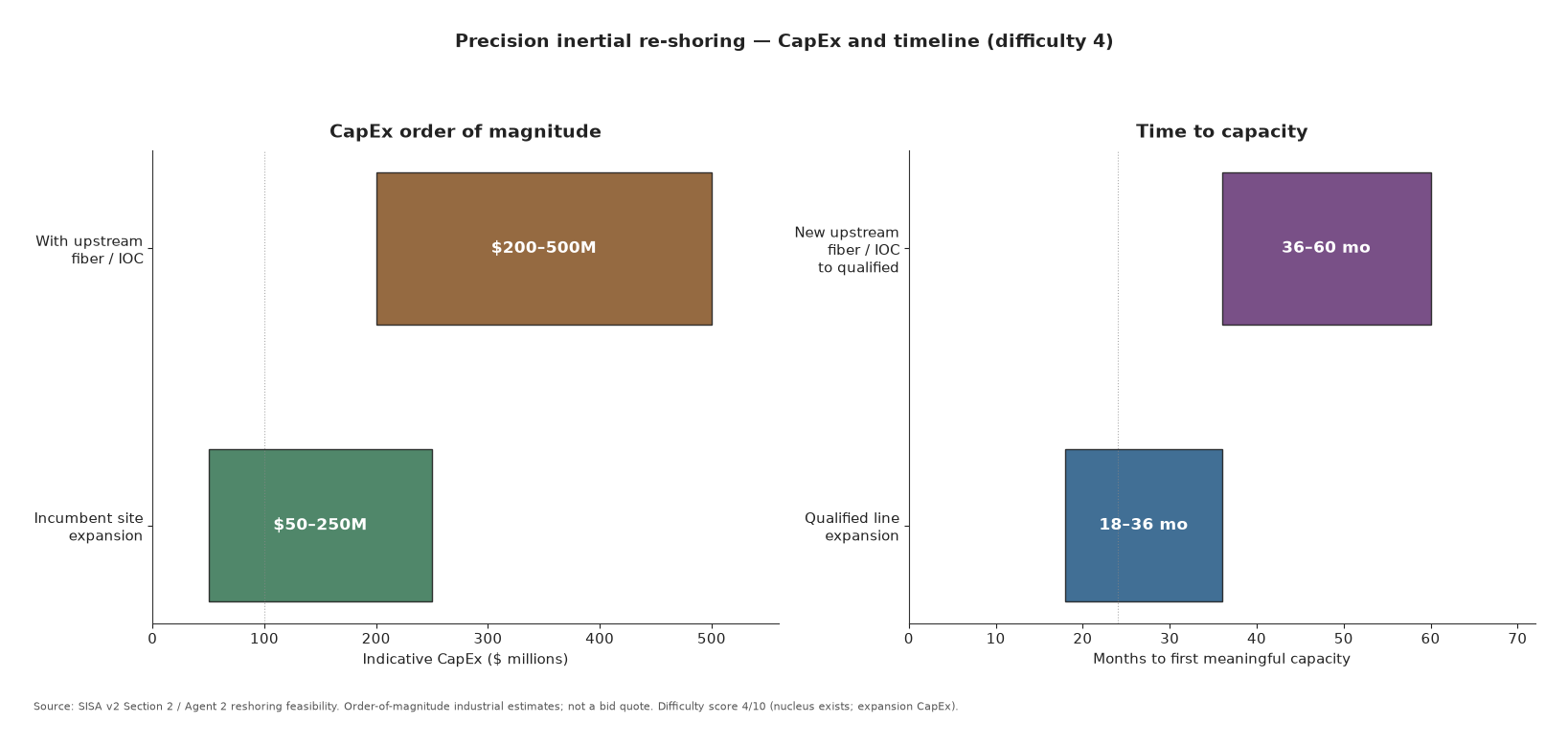
SISA’s scoring rubric puts scores of 4–5 on sectors where a nucleus already exists, CapEx is tens to low hundreds of millions, and skilled labor is tight but trainable. Inertial fits.
| Item | Open-source order of magnitude |
|---|---|
| Incumbent-site expansion (cleanroom, coil winding, test) | $50–250M for a meaningful throughput step |
| Expansion plus upstream specialty fiber / LiNbO₃ IOC | $200–500M+ |
| Time — expand existing qualified lines | 18–36 months to incremental capacity |
| Time — new upstream fiber/IOC to qualified production | 3–5 years (DPA Title III–class investments) |
| Knowledge scarcity | Moderate, not catastrophic — IP and MIL qualification packages sit with incumbents; scarcity concentrates upstream |
Does not require rebuilding titanium sponge or rare-earth magnets as hard blockers for sensor manufacturing itself (platform OEMs may still need those materials). The binding dependencies are specialty optical fiber, IOCs, optical materials, and the people who wind and qualify them.
Compare that to titanium sponge (difficulty 8: zero operating domestic sponge, multi-hundred-million to billion-class plants, atrophied Kroll crews) or commercial cargo ships (difficulty 9.5: decade mega-project and structural cost gap). Inertial is the place where policy can buy sovereignty return per dollar fastest: expand what still works; dual-source the upstream; stop mistaking a finished IMU photo for a full precursor map.
Promethean Action lens: investment timelines, machine tools, and the skilled bench
Industrial CapEx is only half the story. The other half is whether the country still trains people who can run precision processes—and whether machine-tool and apprenticeship pipelines are moving on a useful timeline.
Promethean Action’s physical-economy coverage has been arguing, from an American System vantage, that manufacturing investment, machine tools, and skilled trades are the real leading indicators—not finished-goods rhetoric alone. In April 2026 they walked factory-floor metrics including durable-goods growth and machine-tool orders up 22.5% in 2025 (with early-2026 orders reported still well ahead of the prior year), framing machine tools as “the machines that make the machines.” (It’s Being Built, Baby, Built!) Treat those percentages as advocacy-reported industrial-policy context; cross-check hard claims against AMT/US Census and trade press before writing them into a CapEx model. The direction of the argument matches SISA’s workforce diagnosis: you cannot surge FOG coil winding or optical assembly without a pipeline of hands who have done the work beside a mentor.
By August 2026 the same shop was tracking apprenticeship surges aimed at defense-industrial skills—electricians for ships and installations, shipyard welders, and CNC machinists via National Institute for Metalworking Skills partnerships with primes including General Dynamics, L3Harris, and Raytheon—alongside corporate apprenticeship pledges and BuildFreedom.US as a national ringmaster. (Cutting the Cost of Ambition) That is the right altitude for inertial policy too: DPA offtake and cleanroom CapEx without tacit shop-floor knowledge just buys empty floorspace. A related overview frames Defense Production Act tools, the Office of Strategic Capital, and manufacturing ecosystems—webs of smaller suppliers around anchor plants—as the Hamiltonian path from budget line to lasting productive power. (Beyond the War Budget?)
For precision inertial sensors, translate that lens without romance: fund expansion at incumbent sites first; couple Title III–class money to upstream fiber/IOC second sources; and treat FOG coil winders, optical technicians, and precision assemblers as critical infrastructure people, not afterthoughts in a facilities spreadsheet. CHIPS-class patience applies: multi-year offtake and training matter as much as groundbreaking photos.
Garage literacy: what makerspaces can (and cannot) teach
Garage and makerspace tooling can recover partial literacy adjacent to this category. It cannot recover industrial inertial production.
In scope (educational / hobby only): assemble commercial MEMS IMU breakouts; machine camera or UAV gimbal frames and educational reaction-wheel rotors on desktop CNC; learn PID / SimpleFOC control; practice PCB and lithography literacy so electronics repair is not a lost art. Partial recovery equals skills + mechanical literacy + COTS sensor integration.
Out of scope everywhere in this series: fabricating tactical or aerospace-grade gyros or FOGs; reverse-engineering ITAR IMUs; munitions guidance hardware; seeker assemblies; weapons improvisation of any kind. Garage lithography does not replace merchant MEMS foundries or photonic fabs. If someone asks for a backyard FOG, the honest answer is no.
Civilian Plan B: COTS MEMS only
When industrial-grade IMUs are back-ordered or disaster has stripped certified inventory, civilian Plan B is an information-and-integration problem, not a weapons problem.
Modern phones embed consumer-grade 6-axis (sometimes 9-axis) MEMS IMUs. Peer-reviewed lab work (Capuano, Xu & Estrada Benavides, Sensors 2023) shows pure inertial dead-reckoning with phone MEMS can accumulate more than a kilometer of horizontal error in about 100 seconds—unusable alone for long missions. With tight INS–GNSS fusion and enough satellites, phone-class MEMS stay usable for vehicle and robot telemetry.
Practical pattern for civilian operators only: keep the phone intact (software harvest preferred); fuse IMU with GNSS, vision/optical flow, wheel odometry, or zero-velocity updates; use open AHRS/EKF stacks for inspection UAV/UGV attitude, warehouse robots, camera gimbals, and educational labs. Prefer COTS breakouts (BMI088-class and peers) over phone surgery when you need a durable module. Honest envelope: attitude for gimbals and short inspection hops is good; meter-class outdoor position needs GNSS or vision; indoor corridors need optical flow, ToF, or lidar—do not claim “phone gyro navigation” alone.
Weapons, munitions guidance, and seeker improvisation are explicitly excluded. Plan B exists to keep water systems observed, bridges inspected, and disaster robots flying—not to invent guidance kits.
What “surge” really means
Surge, in this category, does not mean inventing a gyro from a blank whiteboard in six weeks. It means:
- Incremental capacity on already-qualified lines (18–36 months if tooling and people are funded).
- Dual-sourcing upstream fiber/IOC on a 3–5 year clock.
- Preserving process data and mentors when sites consolidate so paper designs do not outlive the crews.
- Accepting that open sources will not tell you exact spare grade-mix inventory—so plan for qualification inertia measured in years if a sole-source node fails.
Policy levers already named in SISA’s ranking matrix: DPA Title III and defense offtake. The strategic mistake is waiting for a zero-capacity crisis (titanium sponge) before spending the relatively modest money that expands a nucleus that still works.
Catalog, protect, adapt — applied here
Catalog every FOG/RLG/QMEMS site, idle cleanroom, and qualified second source for specialty fiber and IOCs. Protect the thin upstream benches and the mentors who staff them. Adapt with civilian COTS MEMS fusion where capital has not arrived yet—and never confuse that adaptation with indigenous aerospace inertial production.
Precision inertial sensors are the lowest-hanging fruit on the re-shoring ranking because America still has something to expand. Expand it. Shore up the photonic and fiber tiers that make expansion durable. Teach makerspace literacy honestly. Keep Plan B civilian. Upstream remains the chokepoint—even when the finished instrument still photographs well.
What’s next
Post 3 turns to titanium sponge—difficulty 8, and a true zero at production scale. USGS reporting shows no U.S. sponge production in 2025 after the last plant closed in 2024; melt shops still run, but on imported sponge and scrap. Magnesium metal as Kroll reductant is a coupled risk. Melt without sponge is incomplete sovereignty. That is the next chokepoint on the map.
← Post 1: Upstream Is the Chokepoint · Next: Titanium sponge (Post 3)
Sources (selected)
- SISA v2 full report §§1.1, 2; Agent 1 diagnostic; Agent 2 reshoring feasibility; Agent 3 garage playbook (educational limits); Agent 4 improvisational blueprint (civilian MEMS only)
- Honeywell Aerospace — Minneapolis navigation hub production figures: honeywellaerospace.com
- EMCORE SEC release / 2023 Annual Report — InP fab closure; QMEMS / LiNbO₃ retention
- Laser Focus World — Northrop FOG consolidation
- GAO-22-104154 — DOD industrial-base risk mitigation
- Capuano et al., Sensors 2023 — smartphone MEMS error bounds
- Promethean Action (investment / machine-tool / workforce context; not sole evidence for sensor technical facts):